Monthly Archives: February 2011

Goshenite, A Diamond Replacement

Goshenite

Goshenite

Goshenite is a member of the Beryl family – the “mother of gemstones”. The beryl species is one of the most important in the gemstone world. Other gemstones of the Beryl family include Emerald, Heliodor, red beryl and Aquamarine.

Goshenite is a clear and colorless stone that was first discovered in Goshen, Hampshire County, Massachusetts, USA. This stone is therefore named after the place it was found first. Goshenite is found in relatively many beryl deposits around the world, so it is perhaps the most common and least expensive form of beryl.

Goshenite was once used for manufacturing eyeglasses and lenses owing to its excellent transparency. These days, it is most commonly used as a gemstone and is also considered a source of beryllium. Before the introduction of diamond simulants such as cubic zirconium, goshenite was often used a diamond replacement.

This stone has a hardness rating of 7.5 to 8 with a hexagonal crystal structure and is a perfect choice for many different types of jewelry including pins, pendants, necklaces, earrings, rings and bracelets. The brilliance and fire could be improved by placing silver foil behind the cut stone.

Since goshenite is relatively plentiful, usually only very clean and transparent specimens are cut as gemstones. Goshenite competes in the market with other colorless gems such as white sapphire, white zircon and white topaz.

Goshenite is known to promote practical wisdom and assists those who have difficulty with the decision making process. It is also reputed as a stone of truthfulness that encourages truth in all actions and particularly in giving one’s word. Goshenite brings self-control, creativity and originality.

www.IndonesiaJewelry.com

Fluorite, The Colorful Mineral

Fluorite Gemstone

Fluorite

Fluorite is a mineral with a veritable bouquet of brilliant colors that range from purple, blue, green, yellow, colorless, brown, pink, black to reddish orange. Fluorite deserves the title “The Most Colorful Mineral in the World” by all means.

Due to its glassy luster Fluorite is highly coveted. Fluorite is the natural crystalline form of calcium fluoride and often forms beautiful cube-shaped crystals.

The many colors of fluorite are truly wonderful. The rich purple color is by far fluorite’s most famous and popular color. It easily competes with the beautiful purple of amethyst. Often specimens of fluorite and amethyst with similar shades of purple are used in mineral identification classes to illustrate the folly of using color as the sole means to identify minerals.

The blue, green and yellow varieties of fluorite are also deeply colored, popular and attractive. The colorless variety is not as well received as the colored varieties, but their rarity still makes them sought after by collectors. A brown variety found in Ohio and elsewhere has a distinctive iridescence that improves an otherwise poor color for fluorite. The rarer colors of pink, reddish orange (rose) and even black are usually very attractive and in demand.

The name fluorite comes from the Latin fluere which means to flow. This name comes from the fact that fluorite melts easily. The mineral flourite was originally termed fluorospar and was first discussed in print in a 1530 work Bermannus, sive de re metallica dialogus, by Georgius Agricola, as a mineral noted for its usefulness as a flux. A flux (from the Latin noun fluxus, a wash or current of water) is used in metallurgy to lower the melting point and promote the fusion of metals and minerals in slag, during smelting.

Fluorite is frequently fluorescent and, like its normal light colors, its fluorescent colors are extremely variable. Typically it fluoresces blue but other fluorescent colors include yellow, green, red, white and purple. Some specimens have the added effect of simultaniously having a different color under longwave UV light from its color under shortwave UV light.

Fluorite is said to absorb and neutralize negative vibrations. It makes one more receptive to the vibrations of other stones. Fluorite should be kept in every room of the home. Fluorite is known as the “Genius Stone”.

Healers use it to help with ulcers as well as the respiratory tract by stimulating cell regeneration in these areas. It fortifies bones, improves arthritic or other joint ailments. It can be laid directly on the body.

www.IndonesiaJewelry.com

Fire Opal

Fire Opal

Fire Opal

Opal is a gem of great antiquity, and comes in two general categories: common opal, also known as “potch,” and “precious opal.” The name “opal” (opale French, opalo Spanish or Italian) is derived from the Sanskrit word “upala” the Greek word “opallios,” and the Latin word “opalus;” all meaning “precious stone.”

There are two categories of opals – common and precious. The Precious opals are composed of three groups: white, black, and fire opal.

Fire opal is an unusual variety of opal from Mexico. You will find two main types of fire opal. One is a translucent yellow, orange or red with no play of color. The other is brownish and has a play of color somewhat similar to the better known precious opal. Fire opals, like all opals, are delicate gemstones, sensitive to stress. Thus they are best suited for earrings, brooches, and pendants and need to be treated carefully.

The Opal contains the colors of all other stones. It can be charged with every type of energy for use in magic spells. Opals have been carried for invisibility. They are also a protection stone used during astral projection. Moreover, fire opal helps relieve energy deficiencies; stimulates sexual organs and the adrenal glands.

www.IndonesiaJewelry.com

Fire Agate

Fire Agate

Fire Agate

Agate is a form of chalcedony or microcrystalline quartz which forms in layers in a remarkable variety of colors and textures.

Indeed agate has an even longer history, since the Egyptians used agate as a gemstone more than 3,000 years ago. But one of the rarest forms of agate, fire agate, has been available commercially only in the last 60 years.

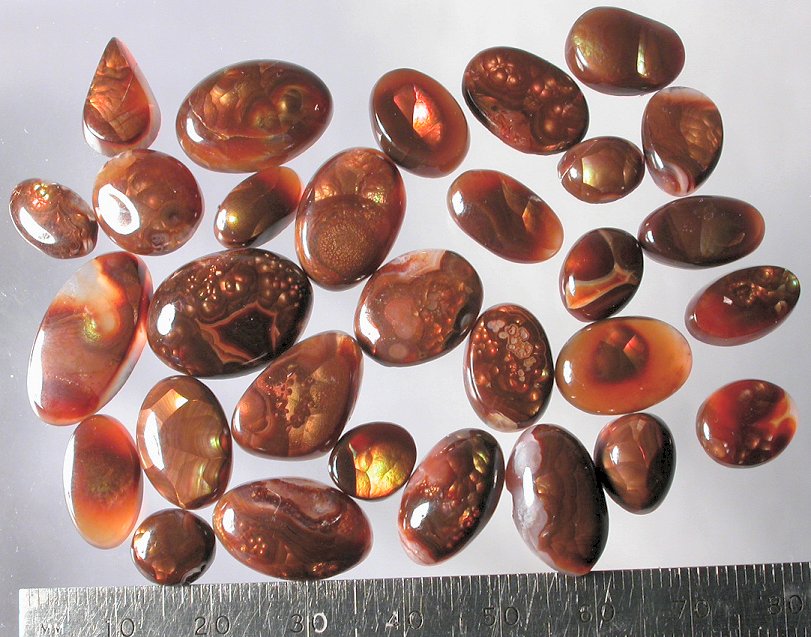
Fire Agate is a layered stone. The layers are small enough that light entering them forms interference colors known as “fire.” Fire agate is a brown agate which has a botryoidal or grape-like growth form. What is special about fire agate is that it contains layers of plate-like crystals of iron oxide (limonite) in various planes. The iridescent colors of red, gold, green and, occasionally, blue-violet, result from interference between diffracted light rays traveling through and reflecting from these thin layers.

Fire agate is a brown agate which has a botryoidal or grape-like growth form. What is special about fire agate is that it contains layers of plate-like crystals of iron oxide (limonite) in various planes. The iridescent colors of red, gold, green and, occasionally, blue-violet, result from interference between diffracted light rays traveling through and reflecting from these thin layers.

Fire agate is found in the southwestern United States and Mexico. It is used for jewelry, figures, sculptures, beads, and many cultures believe Fire Agates contain mystical properties, and will grant the wearer health and protection.

Fire Agate has a deep calming energy that brings security and safety. It is a protection stone with strong grounding powers. Fire agate is believe to heals the stomach, nervous, endocrine systems, strengthens night vision and reduces hot flashes.

www.IndonesiaJewelry.com

Dumortierite Quartz

Dumortierite Quartz

Dumortierite Quartz

Dumortierite quartz is blue colored quartz containing abundant dumortierite inclusions. It is a fibrous variably colored aluminium boro-silicate mineral.

Dumortierite was first described in 1881 for an occurrence in Chaponost, in the Rhône-Alps of France and named for the French paleontologist Eugene Dumortier (1803-1873). It typically occurs in high temperature aluminium rich regional metamorphic rocks, those resulting from contact metamorphism and also in boron rich pegmatites.

Sources of Dumortierite include Austria, Brazil, Canada, France, Italy, Madagascar, Namibia, Nevada, Norway, Poland, Russia and Sri Lanka.

dumortierite, is a stone of order that can enhance organizational abilities, self-discipline, and orderliness. Emotionally, blue quartz greatly reduces problems with scattered mind and disorganization, and brings mental clarity. It also helps one to see and accept reality, and react to it intelligently in one’s behalf.

Physically, blue quartz can help with cooling the body, throat, thyroid, and parathyroid, detoxification, over-stimulation, hyperactivity, spleen, endocrine system, blood.

www.IndonesiaJewelry.com

Diaspore = Zultanite

Diaspore Gemstone

Diaspore

Diaspore is a native aluminium oxide hydroxide. Diaspore is considered to be a semi-precious gemstone and while limited in nature, gems of good color and size are available, however, faceted stones above 5 carat are rare.

Relatively new to the jewelry world, Zultanite (Turkish Diaspore) is a gemstone whose amazing natural color changing abilities make it well suited to savvy jewelry connoisseurs. Zultanite is light toned with a color change of 100%, going from celery green to champagne to raspberry and ginger. Brilliant, mesmerizing and fashionable, the phenomenal Diaspore and Zultanite are rare stars in fine jewelry design, deserving pride of place in every serious jewelry collection.

Mined from a single deposit in the mountains of central Turkey, the name zultanite is a brand name introduced by the man with mining rights to the deposit, Murat Akgun. We assume the name is supposed to reference the sultans who ruled the Ottoman Empire.

Diaspore has reasonably good gemstone characteristics. It has a hardness of 6.5 to 7 on the Mohs scale, comparable to peridot and tanzanite. It has a refractive index of 1.702-1.750, between tanzanite and spinel. Diaspore does have perfect cleavage in one direction, making it a challenge to cut.

Gems that change color under different lighting are rare and diapsore is attracting buyers drawn to this unique quality. Diaspore is a light yellow green (celery green) with color change to medium yellow pink (pinkish champagne).
Zultanite is a light yellow green (celery green) with color change to champagne to raspberry and ginger.

Diaspore deposits have now been found in a number of locations around the world, including Arizona and Pennsylvania in the USA, New Zealand, Brazil, Argentina, Russia, UK and China. But thus far the only gem-quality material has been mined in Turkey.

Diaspore and Zultanite are not strong gemstones and as such, earrings, pendants, pins, and tie tacks are probably the safest choice for these stones. Rings should be limited to occasional wear and the stones should be set with a protective setting.

www.IndonesiaJewelry.com

Dendritic Agate, The Tree Inside The Stone

Dendritic Agate

Dendritic Agate

Dendritic agate is a whitish-gray or colorless chalcedony with tree- or fern-like markings known as dendrites. The variety name agate is used for this gem even though it does not exhibit the banding typical of agate.

Agate is a form of microcrystalline quartz. It is usually formed in nodules and has transparent, or translucent portions. As with all of the other species in the quartz family, agate takes a high polish with cerium oxide. This material does have some fractures.

Dendritic agate can be tricky to cut because the dendrite inclusions occur at various depths in the rough stone. The lapidary needs to cut the material to expose the most interesting patterns.

Because of its dendritic inclusions, dendritic agate bears some similarities to moss opal. But dendritic agate is not called moss agate. In fact there is a another gemstone called moss agate, which has inclusions of green hornblende in moss-like patterns.

Dendritic agate deposits are found in Brazil, India, Madagascar, the USA, Mexico and Khazakstan.

Place one of the stone anywhere that you want to encourage abundance and fullness.

Some of the benefits of tree agate include:

* Enhances the health of house plants
* Creates a peaceful environment
* Deepens your connection to the earth

Be patient when using dendritic agate. It works slowly and takes time to be effective. Use it to encourage a more centered viewpoint in life.

Healers use tree agate to align and correct anything with branches (such as blood vessels, nerves, skeletal disorders). Place it on a point of pain for relief.

Dendritic Agate is believed to aid in communication with nature. It is associated with the protection of the earth, rain, prosperity, abundance, healing, restoration and creativity. It said to improve self esteem and emotional balance.

www.IndonesiaJewelry.com

Demantoid Garnet

Demantoid Garnet

Demantoid Garnet

Demantoid is the green gemstone variety of the mineral andradite, a member of the garnet group of minerals. Andradite is a calcium- and iron-rich garnet.

It is the most expensive and rare of garnet gemstones, with fine specimens commanding prices of thousands of dollars per carat (thousands per gram).

Demantoid garnets are very rare stones that are only mined a few places in the world. Demantoids are valued for their rarity, their beautiful sparkle and their unique form. The gem was first discovered in Russia and the name is derived from its diamond-like adamantine luster.

While the color of demantoid never equals that of the finest emerald, an emerald-green is the ideal. The color should be as intense as possible, without being overly dark or yellowish green. The color of demantoid is believed to be due to chromium. It should be noted that demantoid’s fire is best seen in the lighter, less saturate gems.

Demantoid by definition is always green, but the exact shade ranges from a very strong yellowish green to nearly the color of a fine emerald. Many stones have a brownish cast. Stones with more intense green coloration are more highly valued, but lighter stones display substantially more fire. The choice of stone color or fire can therefore be a matter of personal preference, with some preferring the less valuable but more lively yellowish-green stones.

While garnets have been known since ancient times, the demantoid variety was not discovered until 1853 in Russia’s western central Ural Mountains. The find was about 110 kilometers north, northwest of Ekaterinburg along the Bobrovka River near the village of Elizavetinskoye. This is an alluvial deposit. A second find is 75 km. south of Ekaterinburg on the Chusovaya and Chrisolitka Rivers southwest of the village of Poldnevaya. Deposits are also found underground up to 3 meters deep in the demantoid place.

In terms of clarity, demantoid is relatively clean. Thus when buying one should expect eye-clean or near-eye-clean stones. Demantoids often contain radiating needle inclusions that are termed “horsetails. Some demantoid garnet is heat-treated to improve the color. The resulting stones are stable under normal wearing conditions.

www.IndonesiaJewelry.com

Danburite Gemstone

Danburite Gemstone

Danburite

Danburite is a crystalline mineral similar to topaz. Danburite is not a well-known mineral but is growing in popularity. Danburite has diamond-shaped cross-section and wedge like termination is a contrast to quartz’s hexagonal prisms and pyramidal terminations.

Danburite has a relatively new history compared to other gemstones, having only been discovered in 1839. Through the years, this stone has become popular as a substitute for other stones like topaz. The color of these stones can vary from translucent to pale pink or yellowish brown.

It is a relatively hard crystal and can be polished to produce a brilliant and beautiful finish. The crystal is often confused with other birthstone gemstones such as tourmaline, topaz, apatite and andulsite. This gemstone has become very popular as a fashion accessory and can be found in a wide variety of sizes, cuts and settings.

Danburite was originally discovered in Danbury, Connecticut and can be found in several locales around the world including Mexico, Madagascar, Japan, Central Europe and parts of Southeast Asia.

Danburite is a very spiritual stone that carries a pure vibration. It is excellent for relief of stress and worry. Hold a danburite in each hand for a calming effect and to prepare for deep meditation.

www.IndonesiaJewelry.com

Color-Change Sapphire

Color-Change Sapphire

Color-Change Sapphire

Sapphire is the most precious and valuable blue gemstone. It is a very desirable gemstone due to its excellent color, hardness, durability, and luster. In the gem trade, Sapphire without any color prefix refers to the blue variety of the mineral Corundum.

Color Change Sapphire can be called for those gemstones that are found in various other colors other than yellow and blue. These fancy colored sapphires are available in various hues like yellow, purple, pink, red, black, green and sometimes even translucent. You could also further begin in various other shades and tints of these above colors.

Color Change Sapphires come in a variety of cuts, although oval and round are some of the most popular ones. Apart from them you could find rectangles, squares, oval mix cut, emerald cut, cushion mixed, and various other such kinds of creative enhancements. However, these gemstones are usually sold loose and are untreated. Colors like green, pink, yellow and white are some of the most extensively used on jewelries like bracelets, pendants and necklaces. They have become immensely popular and can be found easily around the globe.

The price range of these fancy gemstones depends tremendously on the quality and the size of the stone. Hence, you need to literally look for good cards and great varieties in them to make them really valuable.

www.IndonesiaJewelry.com