Monthly Archives: April 2011

The Red Blood Pyrope

Pyrope Garnet

Pyrope Garnet

There are several varieties of garnets which differ based on their chemical composition and color. One variety of garnet is pyrope, which are dark red, crimson, orangish-red, or purpleish-red. They are often found without any inclusions and do not need enhancements for clarity or color. Almadine garnets are similar to pyropes, but they are brighter and have a darker color of deep velvety red. These are the most common garnets for jewelry whether they are cut into beads or cabochon, or faceted for elaborate jewelry. Rhodolite is a velvety red garnet with a raspberry red or violet undertone. It is a mix of pyrope and almandine with small amounts of aluminum and magnesium
providing the magnificent color that makes this the most prized garnet.

Pyrope comes from a Greek word meaning “fire like.” The common dark red garnets are a mixture of pyrope and almandine. One popular garnet is chrome pyrope. These are found in Arizona, where ants bring them to the surface. Hence, they are dubbed, “ant hill garnets.” While their color is superb, they are very dark in tone. Gems are rarely faceted in sizes over one carat because of this. In the middle ages, garnet was also called “Karfunkel” in German, referring to the glowing red reminiscent of burning embers.In ancient times it was believed that garnets illuminated the night and prevented the wearer from evil.

Pyrope Garnet is the most famous of the red garnets. Its dark, blood red color is distinct and attractive, often resembling the color of ruby. This gem is often found inclusion free. The impressive brilliance of pyrope garnet is due to it high refraction index. Pyrope is sometimes referred to as “Bohemian Garnet” from its historical source in former Czechoslovakia. Pyrope was the European fashion stone of the 18th and 10th century

www.indonesiajewelry.com

Prehnite The-Unconditional-Love Stone

Prehnite Gemstone

Prehnite

There are hundreds of mineral are have their names after individual, and including numbers of gemstones. But there is one gemstone that has the distinction of being the very first mineral ever named after an individual. The gemstone Prehnite was named for its discoverer, Colonel Hendrik von Prehn (1733-1785), a Dutch mineralogist and an early governor of the Cape of Good Hope colony. Prehnite was also the very first mineral to be named and described from South Africa, long before South Africa became an important source for precious gems.

Prehnite is a hydrated calcium aluminum silicate that occurs in a soft yellow-green to apple-green color. Many specimens have an intriguing luminous quality. It has a vitreous to mother-of-pearl luster. Prehnite is usually cut as cabochons or carved. Specimens displaying the cat’s-eye effect are known but rare. Recently some green translucent to transparent material has been faceted, producing a new look for prehnite that has become popular for jewelry.

Prehnite is a stone of unconditional love. It is said to connect to the archangel Raphael. Prehnite enhances inner knowledge, showing the path forward to spiritual growth through atonement to divine energy. Moreover, Prehnite is said to calm the environment and to bring peace and protection. Its serene energy is said to be beneficial for hyperactive children.

Until recently, prehnite was a rare gemstone, but new deposits have made it more available. While you are unlikely to find it in your local jewelry store, gemstone dealers often have some supply. Deposits are found in South Africa, Australia, China, Scotland and the United States.


www.IndonesiaJewelry.com

Pietersite Gemstone

Pietersite Gemstone

Pietersite Gem

Pietersite is the trade name for a (usually) dark blue-gray breccia aggregate made up mainly of hawk’s eye and tiger’s eye. It was discovered by a man named Sid Pieters in 1962 in Namibia. He registered his find in Britain and the discovery was published in 1964, named Pietersite in his honor. Currently there are only two known sources of pietersite; China and Africa. These two forms of pietersite are similar but still somewhat different from each other. The Chinese pietersite’s fibrous mineral is a magnesium-rich alkalic amphibole. The African (Namibian) variety is mainly crocidolite.

Pietersite belongs to a branch of the tigers eye family called riebeckite. Tiger’s Eye is what geologists refer to as a pseudomorph, one mineral that changes into another. Tiger’s Eye began its life as the mineral crocidolite, a form of asbestos. Unlike tigers eye, the surface of a Pietersite looks rather chaotic, with streaks and colors in every direction. This because during formation of the crystal, the materials that compose it were broken apart, swirled every which way, and then were reformed and cemented together by quartz. Stones and crystals that go through that process are referred to as brecciated.

Colors in Pietersite include various blues, golds and reds, that may appear together or alone. Blue is the rarest color, followed by red. The blues range from a baby blue to dark midnight hue. Golds can be light to very deep and rich, sometimes having a reddish hue. All fibrous color variations will have a superb and striking chatoyancy, the bright and subtly changing shimmer of color that moves along the surface of a gemstone as it is viewed from varying angles.

www.indonesiajewelry.com

Orthoclase Gemstone

Orthoclase

Orthoclase

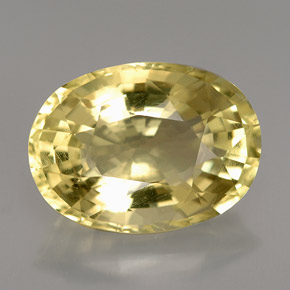
Orthoclase, is an important tectosilicate mineral which forms igneous rock. It came from the Greek for “break straight”, and belongs to the feldspar family of minerals, which also include moonstone, amazonite, spectrolite and labradorite. Orthoclase is a transparent yellow feldspar resembling citrine quartz or yellow beryl and is primarily found in Madagascar. Orthoclase is often colorless or champagne-colored.

Orthoclase have a vitreous luster and resemble other feldspar minerals in crystal habit, methods of twining, and especially by having cleavage surfaces inclined to each other at an angle of 90 degrees, or nearly so. It is often white, gray or flesh-red in color and sometimes occurs as colorless crystals. All feldspars weather readily under the action of both atmospheric agencies and acidic surface waters, yielding a form of clay known as kaolin. Orthoclase is extensively used in the production of porcelain and glass.

www.indonesiajewelry.com

Mystic Topaz

Mystic Topaz

Mystic Topaz

Generally, Topaz of any type is a good jewelry stone and it is historically one of the most important gemstones. With its relatively high refractive index and hardness of 8 Mohs scale, with no special sensitivity to chemicals, it can be used, with appropriate care, which should be protected from hard knocks, in any jewelry application. The name topaz is most probably derived from an island in the Red Sea, “Topazos”, today called Zabargad, the ancient source of peridot.

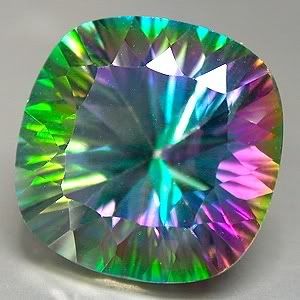
While, Mystic topaz is colorless topaz which has been artificially coated giving it the desired rainbow effect. This gemstone is an enhanced stone that is treated with special properties to give it an extra ordinary look. Mystic Topaz is a patented stone that is only sold in small amounts of numbers each year. However, this stone has become very popular and its popularity is likely to continue.

Topaz in general is very affordable and the sizes of the stones can be large in many cases. If you are looking for a great looking stone that is still traditional, but gives off a wonderful array of colors, look into Mystic Topaz. It should be noted that there are different stones that are sometimes used to create Mystic Topaz; however, usually the colorless stone will give the wearer the best results. Mystic Topaz comes in a variety of sizes and can be very affordable even in sizes above 1 carat.

Mystic Topaz is usually made from colorless Topaz. Colorless topaz is a common form of gemstone, however Mystic Topaz adds a very thin layer of titanium to the bottom of the stone (the pavilion). This small amount of coating causes the stone to give off a beautiful rainbow and iridescent colors. Most stones show beautiful blues, greens, yellows and even warm tinges of red.

Mystic Topaz does not occur naturally, however it is very affordable and usually used solely for ornamental jewelry. One of the more popular uses for this stone is for it to be set in a ring. However, it can also be found on earrings, bracelets and charms.


www.IndonesiaJewelry.com

Mystic Quartz

Mystic Quartz

Mystic Quartz

Quartz is one of the most common minerals on earth and is well known in the gems world. It is attractive and durable, as well as inexpensive, and can be cut and carved in many forms and sizes. Quartz is named after a Slavic word for “hard”. A new high tech enhancement process applied to colorless stones such as quartz and topaz produces an interesting new variety we call “Mystic Quartz”.
Mystic quartz displays a stunning rainbow effect that makes it all at once unique, fashionable and different.

The color, brilliance and clarity of the final product depends on the quality, cut and polish of the original gemstone. That’s why only by the first quality quartz that can makes mystic quartz. Mystic quartz displays all the colors of the rainbow in one stone. The shades of color are displayed in kaleidoscopic designs.

www.IndonesiaJewelry.com

The Pinky Morganite

Morganite

Morganite

In the first decade of the twentieth century, several new gemstone varieties were discovered in Pala, California. They include kunzite, the pink variety of spodumene; and morganite, the pink variety of beryl. Kunzite was named after the famous American gemologist, George Frederick Kunz, who spent most of his career as the chief gemologist at Tiffany & Co. Morganite was named in honor of the legendary financier and gem collector, J.P. Morgan. In fact it was Kunz who suggested naming the newly discovered beryl after Morgan, who was Tiffany’s largest customer.

Beryls are beryllium aluminium silicates rich in minerals. Pure beryl is colourless. However, on account of its structure, it is in a position to intercalate foreign elements such as iron, manganese, chrome or vanadium. If manganese is intercalated in beryl, the rather plain, colourless gemstone turns into an enchanting pink treasure: morganite. Today, this gemstone mainly comes from deposits in Brazil, Madagascar, Afghanistan and California. Its good hardness of 7.5 to 8 on the Mohs scale is the reason for its excellent wearing qualities.

There are morganites in many fine pink hues. Some are decidedly pink, whilst others tend more to lilac or light violet, or there may be a hint of orange. The color of morganite always emanates charm, esprit and a touch of tenderness. This gemstone has a wonderful gift: even in stressful times, it shows up the brighter aspects of life.

Alongside emerald and aquamarine, morganite is certainly the best known gemstone from the colorful group of the beryls. Women the world over love morganite for its fine pink tones which radiate charm, esprit and tenderness.

www.IndonesiaJewelry.com

The Green Rare Maw-Sit-Sit

Maw Sit Sit

Maw-Sit-Sit

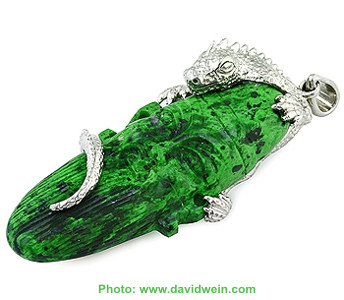
Maw-sit-sit is one of the more unusual gemstones in the world, from its curious name to its variable chemical composition. It is a recent find, first identified in 1963 by the late Swiss gemologist Dr. Edward Gubelin. It was named after the village in northwestern Burma which is close to the site where it was first found. Typically maw-sit-sit is green with distinctive dark-green to black veining.

Maw-sit-sit is a chromium-rich metamorphic rock with brilliant emerald green blotches and bands interspersed with dark green-black blotches. It is found in Tawmaw, Myitkyina-Mogaung District, Kachin State, Myanmar. The source location for maw-sit-sit lies in the foothills of the Himalayas, near the historic imperial jadeite mines of northern Burma. Thus far maw-sit-sit has only been found in this single location, making it a rare material indeed. Because it is so rare, it is a popular gem among collectors but is not readily available through most jewelers. Because the gem is rare, it is typically set into gold rather than silver.

Some of the the confusion between jadeite and maw sit sit has to do with the fact that both stones are mined in the same area. For a long time, many assumed that maw sit sit was just a variety of the jade. It wasn’t until gemologist Eduard Gubelin studied the stones that it was determined that they are, in fact, two separate gemstones.

Maw-sit-sit is considered to be a rock rather than a mineral, since it is composed of a number of different minerals, including kosmochlor (a mineral related to jadeite) and varying amounts of jadeite and albite feldspar. It is often classified as a member of the jade family but it is not really a variety of jadeite. Sometimes maw-sit-sit is called a “cousin” of jade, which seems appropriate.

Mali Garnet, Another Precious

Mali Garnet

Mali Garnet

Mali Garnet, one of the rarer varieties within the garnet group, is a mixture of the species grossular and andradite, therefore it is sometimes called “grandite.”

In the large and varied garnet family of gemstones, there are six common varieties that are recognized based on their chemical composition: pyrope, almandine, spessartite, grossularite, uvarovite and andradite. There are also some mixed members, such as rhodolite garnet, which is a mixture of pyrope and almandite by composition. New hybrid garnets continue to be discovered. In 1994 a mixture of grossular and andradite garnet was discovered in the West African country of Mali, and was named mali garnet. This discovery drew a lot of interest because the grossular and andradite varieties are among the rarest and most valuable garnets. Members of the grossular group include tsavorite and hessonite. The most famous member of the andradite group is the rare demantoid garnet.

Grossular Garnet is found in a variety of colors including, yellow, brown, white, colorless, green, violet red, and orangey red. Stones from the deposit in Mali are typically yellowish green or brownish green. Some gemologists refer to them as a grossular-andradite mixture.

The most valuable mali garnet is the extremely rare chrome green color. Generally speaking, yellow, greenish yellow and yellowish green stones sell for higher prices than the brownish stones. As with any gem, size, clarity and cut can affect the value significantly, with dispersion being a special value factor for Mali garnets.

www.IndonesiaJewelry.com

A Purplish Lepidolite

Lapidolite Gemstone

Lapidolite

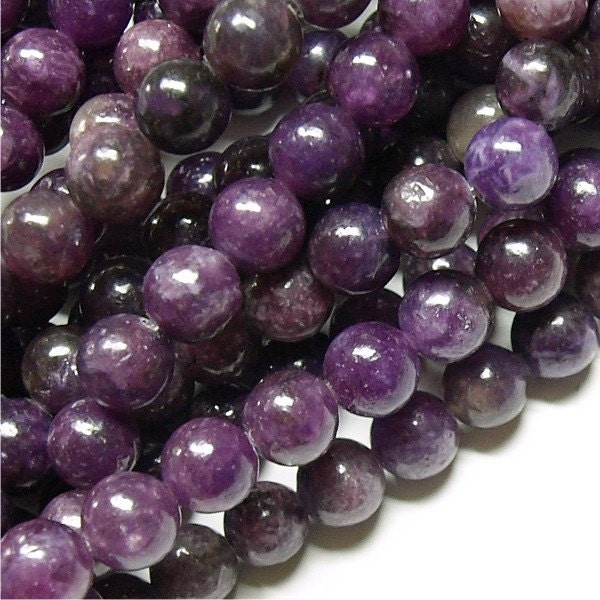
Lepidolite is a lilac-gray or rose-colored phyllosilicate mineral of the mica group that is a secondary source of lithium. The mineral is noteworthy as one of the major sources of the rare alkali metals rubidium and caesium.

The lithium content in lepidolite does vary greatly however and low lithium lepidolite is nearly useless as an ore of lithium. The typical violet to pink color of lepidolite is characteristic and is the only field test available to identify lepidolite from other micas. Pink muscovite or very pale lepidolite may confuse an identification.

When Lepidolite was first discovered in the 1700’s, it was given the name Lilalite, for its lavender color (from the Hindu word ‘lila’ meaning play, game). Scientists eventually renamed the stone lepidolite, from the Greek lepidos meaning “scale.” The reference is to the scaly appearance of lithium flakes in the mineral. Lepidolite is not technically a gemstone, but a very beautiful purplish referred to by healers as the Peace Stone. Lepidolite can be laid directly on painful parts of the body. It helps with nerve pain, sciatica, neuralgia and joint problems.

Lepidolite, like other micas, has a layered structure of lithium aluminum silicate sheets weakly bonded together by layers of potassium ions. These potassium ion layers produce the perfect cleavage. lepidolite crystals accompany such other lithium bearing minerals such as tourmaline, amblygonite and spodumene and can add greatly to the value of these specimens. A rock made of granular pink lepidolite and red to pink tourmaline is used as an ornamental stone for carving. Single large plates or “books” of lepidolite can have appealling violet color and make attractive mineral specimens.

Noteworthy deposits have been found in Brazil; Ural Mountains, Russia; San Diego County, California; Mexico; Tanco Pegmatite at Bernic Lake in Manitoba, Canada; Madagascar and Zimbabwe.