Monthly Archives: September 2011

The History Of Engagement Ring

The History Of Engagement Ring

Engagement Ring

Literally, engagement ring is a ring that worn by those whom engage and getting married. In some culture or country the use of engagement ring is vary. In UK, Ireland and North America, the engagement is traditionally worn by women only. While, in other culture both men and women are worn the ring. In other culture, the engagement ring is just the same as wedding ring.

Conventionally, the meaning of engagement ring represented a gift by a man to his beloved while after he proposes marriage or after the lady accepts the proposal. In other hand, it such the practice of sealing the marriage contract with a ring. While, today some say that engagement ring is a symbol that you and your love one is having serious relationship and there is plan to be married in some other time.

Regarding the symbol of the relationship, at the early begin of this issue, there were not a patent symbol that mention about valuable ring becomes the subject matter. The thing that made a symbol is about the circle. It was adapted by the culture from the ancient that circle is symbolizes perfections, unity, peace, holiness and endlessness because of its no beginning and no end.

People in the Ancient Europe used hair knots as circle rings and it was a symbol of love, faith, friendship. The early rings were made from materials like iron, copper, silver and gold became popular during Medieval period. The reach class usually uses the gold and silver ones. During times, the rings became jewelry in the 14th century.

Christians started to use rings for their wedding ceremonies in 8th century. As a symbol of love. Wedding rings were first documented in second century by the Roman poet of Plautus. Egyptians were known using wedding ring as a symbol. Wedding rings and bands were mentioned in the hieroglyphics on the walls and tombs. Egyptians used for bands heavy metals encrusted with precious stones. Until the 15th Century only Kings wore diamonds as a symbol of strength, courage and invincibility. Over the centuries, the faceted diamonds (diamonds that produce sparkles with internally reflected light and shows off the “fire” of the stone) acquired their unique status as the ultimate gift of love.

Today, the engagement ring has its own place to be the only symbol of love between the lovers. Practically, there are millions of idea to bring the beauty into a piece of ring and become the new prestige among the user, instead to represent the basic meaning.
www.IndonesiaJewelry.com

Pledge Pin

Pledge Pin

Pledge Pin

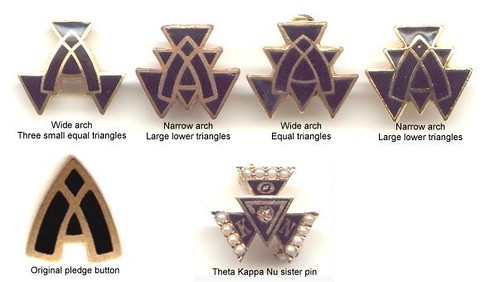
Pledge is refer to those who are agree to join into a fraternity or sorority in a batch of college. The member of the sorority or fraternity is being called as pledges or aspirants, but since 1972 it became Associate Member.

For those who join the fraternity or sorority as pledges or associate member will get pin based on their membership and to show their existence. This pin is called as pledge pin. The member must worn for the duration of the pledging period, usually during all times which not considered dangerous to do so, like during sport or some feud events. All pledge pins, therefore, were made with a threaded post and were affixed to the left coat lapel through a buttonhole and secured by a brass disc screwed onto the back.

www.indonesiajewelry.com

Signet Ring

Signet Ring

Signet Ring

Signet ring is a ring that worn by individuals bearing an initial, monogram, or other image to denote the identity and, long ago, the social or noble status of the wearer. Moreover, Signet rings have been used to affix personal identification marks and stamps of approval to documents throughout history. Signet rings are ornamental pieces of jewelry that have traditionally been adorned with coats of armor, family crests or symbols representing membership in specific organizations or associations. When pressed into a blob of hot wax, the signet ring doubles as a personalized stamp of approval.

Hence, the signet ring’s original purposes of indicating rank and imprinting seals on important letters are no longer concerns in the modern western world, but the beauty of signet rings and their interesting background have kept them alive as stylish fashion accessories for men and women.

Signet ring have a long and illustrious history and figure prominently in a great deal of well known artwork and literature. The earliest types of gold signet rings were found in the tombs of the ancient Egyptians, the same society that was first to fully incorporate wedding and engagement rings into their religious ceremonies and hold them as important social constructs.

The most common types of signet rings currently worn are made from white or yellow gold and engraved with the initials or simply the first letter of the wearer’s first name. The variety of shapes, widths, and styles for the ring and the number of fonts from which to choose to create engravable signet rings allow you to personalize your gold signet ring in a number of ways not limited to your initials.

The term signet ring or seal has its origins in the Hebrew and Greek words “hotam” and “sphragis.” Original signets were put to use much the same way as today’s signatures or signs of authority and were displayed on documents, doors or tombs. The Bible contains stories of the signet ring or seal both literally and metaphorically.

Signet rings in ancient Egypt were made from stone. They were flat on one side, round on the other. The flat side was ornately decorated with inscriptions, symbols, hieroglyphics or images of the scarabaeus or the sacred beetle, which was worshipped by both Egyptians and Phoenicians as well as other ancient cultures. These seals were occasionally made from blue pottery.

During the Middle Ages, signet rings were used to show that the wearer was privileged and as a means of sealing letters to prove their authenticity. Before long, signets rings and seals were the single indicator that legal, government and business documents were genuine. Beginning with the reign of England’s King Edward II (1307-27) and ending in 1851, the seal from the king’s signet ring was required on all official documents.

Today, the signet ring is no longer accepted as a legally binding signature or an indication of authenticity. However, it continues to be worn by individuals who choose to publicly display their family lineage or affiliations for all to see.

www.indonesiajewelry.com